Showing posts with label Valladolid. Show all posts

Friday, May 12, 2017

An Indiana-Jones-trip to the cenotes and pyramids of the Yucatan

Las Tres Chicas, swimming in a cenote
Swimming in a cenote is similar to starring in an Indiana Jones movie. Slippery stone stairs lead to a dark cavern filled with crystal clear water.

The Tarzan-style vines, the roots of above-ground plants, hang from the ceiling of the cavern. The slow drip of minerals forms stalactites, their whimsical shapes reaching for the water below. An occasional bat flitters past in the dim light. Dozens of swallows nest in the underground crevices, zipping underground via a hole in the earth above. Exquisite and eerie.

Ek Balam pyramid and surrounding structures
Last week, I posted a question on my Facebook page, asking for recommendations for a tour company for a day trip to the Ek Balam pyramid and a swim in the cenotes. The response was immediate and varied. Many recommended either William Gonzalez or Patricio Astudillo. 

We dithered, but in the end, we went with William because a number of our close friends had taken his tours and really enjoyed the experience. In years past, when we owned a car, we frequently drove our visitors to the pyramids. Currently, our only form of transport is a golf cart, and that just isn’t fast enough, nor legal, for a two-hour drive on a four-lane highway. Two great-nieces, Lauren, Ellen, plus their good friend Amber, who has become a great-niece via friendship, and I decided to go. We left Lawrie and Sparky at home to enjoy some peaceful guy time.

Heading out on our adventure
We caught the seven-thirty UltraMar passenger boat from Isla Mujeres to Puerto Juarez on the mainland, and met up with Manuel, who was our tour guide for the day. Settled into a comfortable seven-passenger van, we headed towards Valladolid and the less busy pyramid of Ek Balam. Lawrie and I have enjoyed several visits to the large pyramid of Chichen Itza, but it has become so crowded that it is difficult to get good photographs without including several hundred strangers grinning inanely at their selfie sticks.

Ek Balam, the Black Jaguar, is located thirty-five kilometers north-east of Chichen Itza, in the municipality of Temozón. The road turns off the toll highway #180, a few kilometers from the City of Valladolid, in the direction of Tizimin. Tizimin is well-known for handmade tropical wood furniture.  
Royal Palace at Ek Balam 106 steps up

The road between Cancun and Valladolid is straight, boring, and the flat vista is blocked by thick undergrowth. The secondary road is more interesting but populated by hundreds of topes, speed bumps, in the numerous villages, increasing the drive to three hours instead of two. It’s a good time to let someone else do the driving, so you can doze in the warm sunlight or chat with your travel companions.


By ten in the morning, we were at the pyramid. The entrance fee is 193.00 pesos for foreigners, but lucky me, I have an INAPAM card telling the world that I am old and a local. My entrance fee was 0 pesos. You do have to produce proof of residency, such as an electrical bill or water bill in your own name, and proof of age, to obtain this Mexico senior’s card from your municipality. For Lawrie and me, the savings are helpful. 

Inside Ek Balam, we hired a local guide to show us around. José was born in a nearby village, and his first language is Mayan, but he also speaks Spanish and English. 

  
Jose taking pics of my travel partners 

Our guide was well-informed and interesting, telling us the history of each structure and the meaning of the various glyphs. 

I envied the ease with which José climbed the one hundred and six stairs to the top of the Royal Palace, and then nonchalantly strolled back to ground level while everyone else baby-stepped their way down the steep pyramid. 

It’s a combination of vertigo and the insecurity of flip-flops on narrow, slanted steps that makes the descent more challenging.   
  
The tourist photo!
Next stop was the Samula and the nearby X’kekén cenotes in the town of Dzitnup. The cenotes are part of an underground river system that flows under the limestone base of the Yucatan Peninsula. Over time, bits of the ground above have been worn away by rainstorms, animals, or humans, creating entrance holes to the subterranean fantasy world.

In the aquamarine water, small black fish laze; a type of catfish, perhaps? Others nibble at our feet. They remind me of the fish imported from Turkey, used for pedicures in some of the upscale Cancun hotels. Hopefully, no one would be foolish enough to populate the pristine Caribbean waters with another imported species of fish, creating a local ecological problem like the venomous Indo-Pacific lionfish. 

Doctorfish doing pedi
The little fish didn’t bite, but it was an odd feeling to have so many small mouths scouring my skin.

As for the cenotes, the entrance fee for each one is 59.00 pesos for visitors, and half of that for people with an INAPAM card. 

Some locations sell a two-day pass that covers all of the locations, but for us, two in one afternoon was sufficient. We spent about an hour and a half lazing around in the water before meeting up with our driver, Manuel.

Restaurante el Atrio del Mayab
By now it was one in the afternoon, and we were starving. Manuel suggested that we have lunch in Valladolid at the Restaurante el Atrio del Mayab. Wow!  

Beautiful setting right off the square in centro, near the cathedral, and diagonally across from one of our favourite hotels in Valladolid, the El Mesón del Marqués. The food was delicious, the cerveza cold, and the service excellent.

On the drive home, our group was strangely quiet as our heads lolled against the vehicle windows. Full of good food and feeling sleepy, we hardly talked until we were at the UltraMar terminal, headed back to Isla Mujeres.

Hasta Luego, Lynda


Murder and mayhem. Revenge and romance. 

Grab your copy today! 


Friday, February 27, 2015

A road trip to our favourite places, Valladolid and Izamal Mexico

Centro Izamal Yucatan, Mexico
“I wonder if Sylvia knows where we are?” I joked as we turned down yet another tiny, unmarked street in the colonial town of Izamal. 

I was referring to John's iPhone GPS. We were looking for the route back to Highway #185 and Valladolid.

Franciscan monastery in Izamal
About a three-hour drive from Cancun, Izamal is one of our favourite places in the Yucatan Peninsula to take visitors. Settled in the 1540s by the Spanish, the city and the Franciscan monastery were built directly on top of an old Mayan temple. The monastery and many of the buildings in Centro have traditionally been painted a mellow egg-yolk gold. Even though the reason for the monochromatic hue has been lost over the decades, the golden colour gives a lively, vibrant look to photographs.
Our favourite Kinich Restaurante
Lawrie and I typically travel with maps, but since we have been to Izamal a few times in past years, we thought we knew where we were going, and he normally has a fine-tuned sense of direction. However, when driving on roads that wind through cramped, narrow streets on flat, featureless land, the topography looks the same all the time. Full from a spectacular lunch at our favourite eatery in Izamal, the Kinich Restaurante, we were a bit drowsy and probably missed the rare and sun-faded directional signs. So, John and his iPhone came to our rescue!
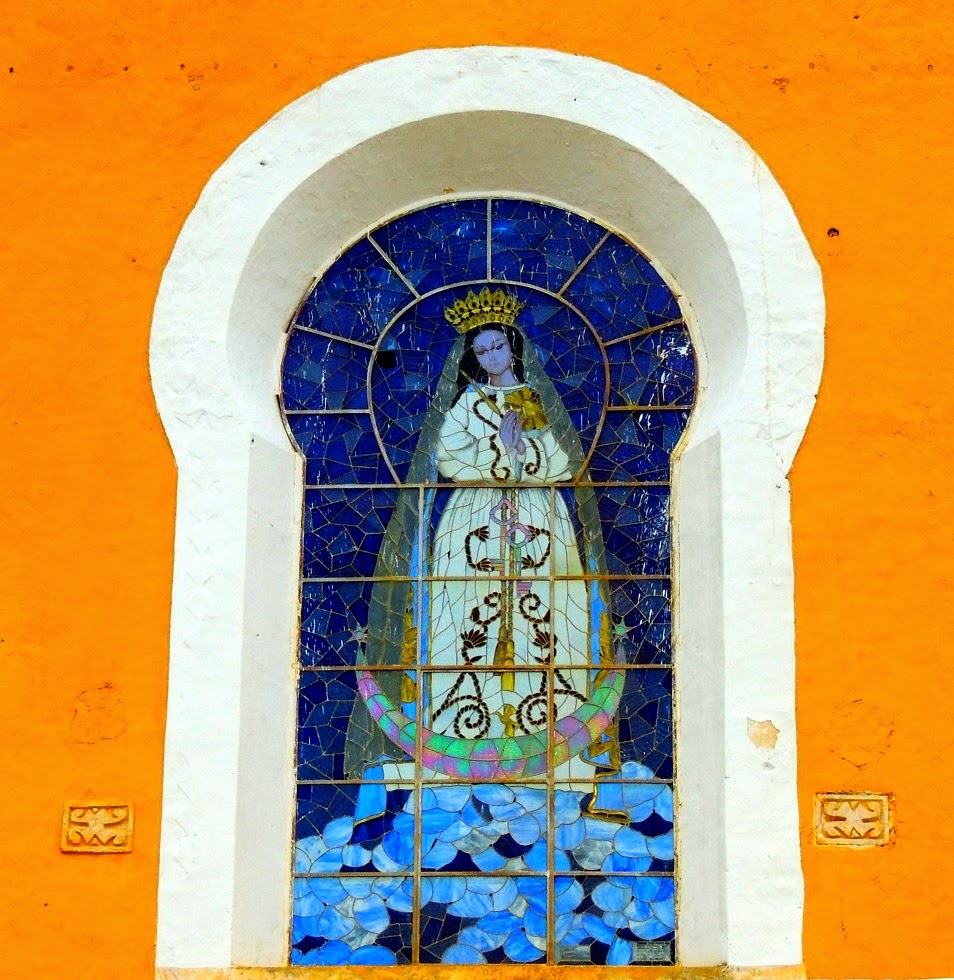
Stained glass window, Izamal
When asked, Sylvia, the iPhone politely informed us we were headed in the wrong direction. She then dispensed step-by-step instructions for multiple turns onto tiny one-way roads, including exactly how many meters before our next turn onto yet another dust-covered alley, wending our way to the intersection of the highway. 
 I take back every sarcastic comment I have ever made about people relying on GPS! Sylvia, the iPhone is a very knowledgeable lady.
Valladolid in the evening
Getting into the centre of Valladolid was easy; we had been there many times and we had good instructions – the pen and paper kind – for finding our hotel. The Casa Tia Micha is a tiny B&B a few steps off the square. With a total of three guest rooms available is probably the tiniest hotel that we have ever booked. The front entrance is quite plain, with a black metal gate opening up to a delightful entrance and courtyard. The B&B is beautifully decorated with great attention to detail; comfy beds, good showers, a complimentary bottle of wine and two nice wine glasses. Just perfect!
Our room at Casa Tia Miche, Valladolid
In the morning, co-owner Rosanelly Ayora Sosa treated us to a tasty three-course breakfast of regional dishes, a great start for our day of roaming the Mayan ruins of Chichén Itzá. Settled in around 600 CE and abandoned in the late 1500s, Chichén Itzá was rediscovered by European explorers in 1842. The entire complex was buried under an accumulation of trees, vines, and other assorted vegetation that had grown unchecked. By 1923, the Mexican government was interested in excavating the main parts of the city. Excavation projects are ongoing at the site as more structures have been located, some buried underground, some deep in the jungle.
Our travel partners - Maia and John at Chichén Itzá
We arrived at the complex around 9:30 in the morning. We had three hours of relative peace - to take photos, read information plaques, cruise past the hundreds of vendors and leave before the dozens of tour buses from Cancun, Playa del Carmen, and Mérida disgorged their sunbaked passengers.
Turning back to Valladolid, we headed to our other favourite restaurant, the Taberna de Los Frailes, for a late lunch. Serving tasty regional specialties, the Taberna is a great place to relax and enjoy time with family and friends. The eatery is located in a sub-district of Valladolid called Sisal, beside the Convento of San Bernardino de Siena. The Convento (monastery) was built between 1552 to 1560 by the Franciscan monks and was in use until 1755, when it was abandoned. A self-guided tour of the property is a good way to walk off a few lunch calories.

San Bernardino de Siena
Early the following morning, we enjoyed our last tasty breakfast before setting off on our return trip to Isla Mujeres. We decided to drive the “libre” road, the toll-free, slower route, and more interesting than a four-lane, dead-straight, nothing-to-see route.


TriciTaxis - Leona Vicario
We bumped our way over the topes (speed bumps) of each small village, passing plant nurseries, handicraft stands and small restaurants. In Leona Vicario, we were surprised to see motorcycle-based TriciTaxis, buzzing around, carrying students to and from school, shoppers, supplies – anything. Cool idea!

Casa Tia Miche, Valladolid

And then finally we were headed home on the car ferry, content, tired, and ready to chill out for a few days in our island paradise.
We love road trips! And we really love getting back to our home.

Saturday, January 7, 2012

“Hagamos un viaje por carretera” Let’s take a road trip!

When our friend Janet tore off the page on her Living Language day-by-day Spanish calendar to reveal the words of wisdom for the day this is what she discovered – “Hagamos un viaje por carretera.” Let’s take a road trip! Prophetic words indeed!

Sun's comin' up while we're on boat.
We had arranged to pick up Janet and Dave at 5:30 in the morning so that we could catch the first car ferry off the island, which leaves at 6:00 a.m. Dave, it turns out, is definitely not an early morning person. He doesn’t do “o-dark-hundred.”  He was still grumbling about getting up at 4:45 when we picked them up at 5:30 a.m. He grumped more while on the ferry, and still more as we drove towards Valladolid. In his world, morning doesn’t start until 8:00 a.m. We even supplied him with a pillow so that he could resume his beauty sleep.

I had originally planned a pretty rigorous agenda for the day: pottery shopping in Leona Vicario (a small hamlet near Cancun), then Valladolid for breakfast, next Ek Balaam temple ruins, then Rio Lagartos to see the flamingoes, and return to Punta Sam to catch the last car ferry around 8:15 p.m. It didn’t quite happen that way, but we had a fun day with lots of laughs, all the same. 

Valladolid Centro

I drove, Dave co-piloted, and Janet and Lawrie navigated from the back seat.  We had breakfast in Valladolid at the Hotel el Meson del Marques, which is turning out to be one of our favourite places to stay and to eat while on road trips. Then we headed north (I think, but have absolutely no sense of direction) towards the Ek Balaam temple. 

As it was already 10:00 in the morning by this time I suggested that we bypass our visit to the ruins to the accompaniment of sighs of relief from both Dave and Lawrie. In their words: "seen one ruin, seen ‘em all."

We made pretty good time on Highway 295 until we hit Tizimen, a medium-sized town between Valladolid and Rio Lagartos. All the streets are one-way, which is pretty common in the colonial towns that were built before the invention of vehicles, as the streets are now too narrow for two-way vehicle traffic. But they were one-way with no directional signs other than “Tizimen Sorriana’s,” which I took to mean that this was the way to follow. Nope! It took us to the Sorriana's grocery store in Tizimen. It was a great place for a pit-stop to use the very clean baños.  Then, in desperation, I turned to the back-seat drivers and said, “Which way?” Lawrie and Janet both said north. Okay, where the hell is north?  Dave said turn left, they said turn right, turns out the driver and co-pilot had absolutely no sense of direction, but the two back-seat drivers were right bang on, and we found highway #295 again.

Calotmul Cathedral.
The next photo op was a very small town called Calotmul with a beautiful but abandoned cathedral.  Just a quick stop to take a couple of photos and back on the road again. We discovered that the road from Valladolid to Calotmul has many, many furniture makers that display their chairs, stools, tables and other wares along the roadside. It would be a good place to shop if we were in need of furniture.

We arrived in Rio Lagartos around noon and headed to the Rio Lagartos Adventures and Torreja Restaurant, owned and operated by Diego Nunez and his family. He was recommended to us by another island friend, Harriet Lowe. 

Thousands of birds on the Rio Lagartos

We had an interesting two-hour long boat trip up the river. We saw flamingoes, osprey, storks, herons, and other fascinating birds. Diego took us through the mangroves on the off chance that we would spot a crocodile, but they are nocturnal so no luck there.  He also suggested that we might want to participate in the mud baths, but fortunately none of us had brought bathing suits so we could skip that dubious pleasure. I don’t know, but somehow the idea of plastering ourselves with a combination of sand, mud and bird poop just didn’t do it for us.
Folks who did the mud bath (sand and bird poop) option
By the time we got off the river boat a nasty storm was hanging over the community of Rio Lagartos. We managed, with a few wrong turns down unmarked one-way streets, to find Highway 295 back in the direction of Valladolid. Then the storm hit! Ugly but short.  

Rio Lagartos

Our adventure back through Tizimen was almost as exciting as the first time. We drove straight into town on Highway 295 only to discover, as the locals were madly waving at us, that it suddenly turns into a one-way the wrong way!  Damn-it! We turned around, headed left!  Nope – dead end! Turned around again, and headed back towards the group of guys who were hanging out on the street corner laughing at us. One of the guys was motioning towards the road that we should have taken. Faking embarrassment Dave hid behind his pillow while the woman-driver stopped and thanked the guys for helping us out, that made them laugh even harder! 


Our favourite restaurant in Valladolid

Back in Valladolid by around 4:30 p.m., we decided to have an early dinner at the Taberna de Los Frailes (Friar’s Tavern) near the nunnery.  It’s a great spot with a pleasant ambiance, and a varied menu, except of course, not everything is available all the time. We arrived back at the UltraMar water taxi at Puerto Juarez around 7:30 p.m., having decided to leave the car on the Cancun side for the night.

Lawrie and I love road trips, and they are a heck of a lot more fun with willing adventure partners. Let’s do another road trip soon, and yes, we will be leaving again at o-dark-hundred!

Hasta pronto, Lynda and Lawrie


Tuesday, November 15, 2011

Valladolid Mexico: the colourful "sultaness of the east"

Cathedral Valladolid, undergoing restoration.
It is always great fun to see our world through the eyes of our friends. Last spring, we took a road trip to another of our favourite colonial cities, Valladolid, located on the eastern side of the Yucatan Peninsula of Mexico.
We left Isla Mujeres on the 9:30 a.m. car ferry, as we couldn’t see the point of dragging everyone out of bed at 5:00 a.m. to catch the earlier boat. I was up early anyway, in excited anticipation of a road trip; a Christmas-morning-can’t-wait-to-rip-open-the-packages feeling. The drive to Valladolid is always a long, boring trip on an almost dead straight road through a dense jungle of trees just tall enough to block your view.

The road has one well-marked but very gentle S-curve and one tollbooth stop. Other than that, if we had had an autopilot system, we all could have tucked pillows behind our heads and snoozed for a couple of hours.

Valladolid Centro Public Park
By North American standards, Valladolid is a very old and beautiful colonial city.  The city was originally established on a lagoon a few miles away, but the early Spanish settlers complained about the mosquitoes and petitioned to have the city moved further inland in the mid-1500s. I can sympathize with them.  I hate mosquitoes! The City of Valladolid has undergone a major facelift in the last year or two, with a repaint of all of the city square businesses and homes in shades of pale pink, soft green, sherbet orange, glowing amber and glistening white. The cathedral and city square park are also being refurbished.  It’s a visual feast for the eyes.  

Our favourite restaurante in Valladolid
We arrived in Valladolid shortly after 12:30 p.m., and drove on a meandering route through the city, trying to remember the way on their narrow one-way-only streets to the Taberna de Los Frailes (The Friar’s Tavern). 
About the time our friends became convinced that we didn’t have a clue as to where we were going, and they were surely going to starve to death, or die of dehydration locked inside the car, we found it! Well darn. The restaurant was closed. I glanced at my wrist watch and realized it was only 12:45, and the lunch hour had not yet started. I popped around the corner to the outside patio, where a waiter was setting up for the day and asked him in my really bad Spanglish what time they were due to open.  Twenty minutes –perfect. 
Convent of San Bernardino de Siena
Across the street from the Taberna de Los Frailes is a large structure that had been the Convent of San Bernardino de Siena.  We decided to walk around it and take a few photos while we waited for the restaurant to open. Much to our delight, we discovered it was open and available for self-guided tours for a small entry fee of 30.00 pesos (about $3.00 CDN). 
Built from 1552 to 1560 by the Franciscan monks, the Convento (actually a monastery) of San Bernardino de Siena was in use until 1755, when it was abandoned. At some point in time, an effort was made to restore the building as much as possible and to use it as a church, meeting hall, and community gathering place. The soft peach-pink tones of the ancient sandstone exterior have been accentuated by the lovely pink colour of the interior plaster. 
One of my favourite photos, inside monastery
To the locals, this imposing cathedral is called “Sisal,” the ancient name for their small town.  Part of the building was erected over the vault of a very large cenote, an underground water-filled cavern that was created millions of years ago in the soft sandstone by rainwater. 
The monastery was created to be self-sustaining with huge orchards, vegetable gardens and fresh water from the cenote. (No mention was made of whether or not the monks operated a distillery on the property, strictly for medicinal purposes, of course. Maybe Tequila? Or a Tequila-brandy?)
After wandering through the monastery, we enjoyed a wonderfully tasty lunch and a glass of wine at the Taberna de Los Frailes. 
I then dragged my friends into my favourite store in the centre of Valladolid. Yalat is a wonderful store, with hand-made linens from various areas in Mexico. Expensive! But fabulous. 
Surinder, Lawrie and Jenda  waiting for car ferry
Happy, tired out, and ready to head home, we retraced our route, catching the last car ferry from Punta Sam to Isla Mujeres.
Hasta Luego
Lynda and Lawrie 


The humble beginnings and true life tale of Sparky, hero of the Isla Mujeres Mysteries: Chapter 12

  Chapter 12 I’m going to be famous! “I’m bored,” said Servant. Driver, Servant, Tommy, Chica, and I are all snuggled on the big sofa ...