Showing posts with label Izamal. Show all posts

Friday, February 27, 2015

A road trip to our favourite places, Valladolid and Izamal Mexico

Centro Izamal Yucatan, Mexico
I wonder if Sylvia knows where we are?” I joked as we turned down yet another tiny, unmarked street in the colonial town of Izamal

I was referring to John's iPhone GPS. We were looking for the route back to Highway #185 and Valladolid.

Franciscan monastery in Izamal
About a three-hour drive from Cancun, Izamal is one of our favourite places in the Yucatan Peninsula to take visitors. Settled in the 1540s by the Spanish, the city and the Franciscan monastery were built directly on top of an old Mayan temple. The monastery and many of the buildings in Centro have traditionally been painted a mellow egg-yolk gold. Even though the reason for the monochromatic hue has been lost over the decades, the golden colour gives a lively, vibrant look to photographs.
Our favourite Kinich Restaurante
Lawrie and I typically travel with maps, but since we have been to Izamal a few times in past years, we thought we knew where we were going, and he normally has a fine-tuned sense of direction. However, when driving on roads that wind through cramped, narrow streets on flat, featureless land, the topography looks the same all the time. Full from a spectacular lunch at our favourite eatery in Izamal, the Kinich Restaurante, we were a bit drowsy and probably missed the rare and sun-faded directional signs. So, John and his iPhone came to our rescue!
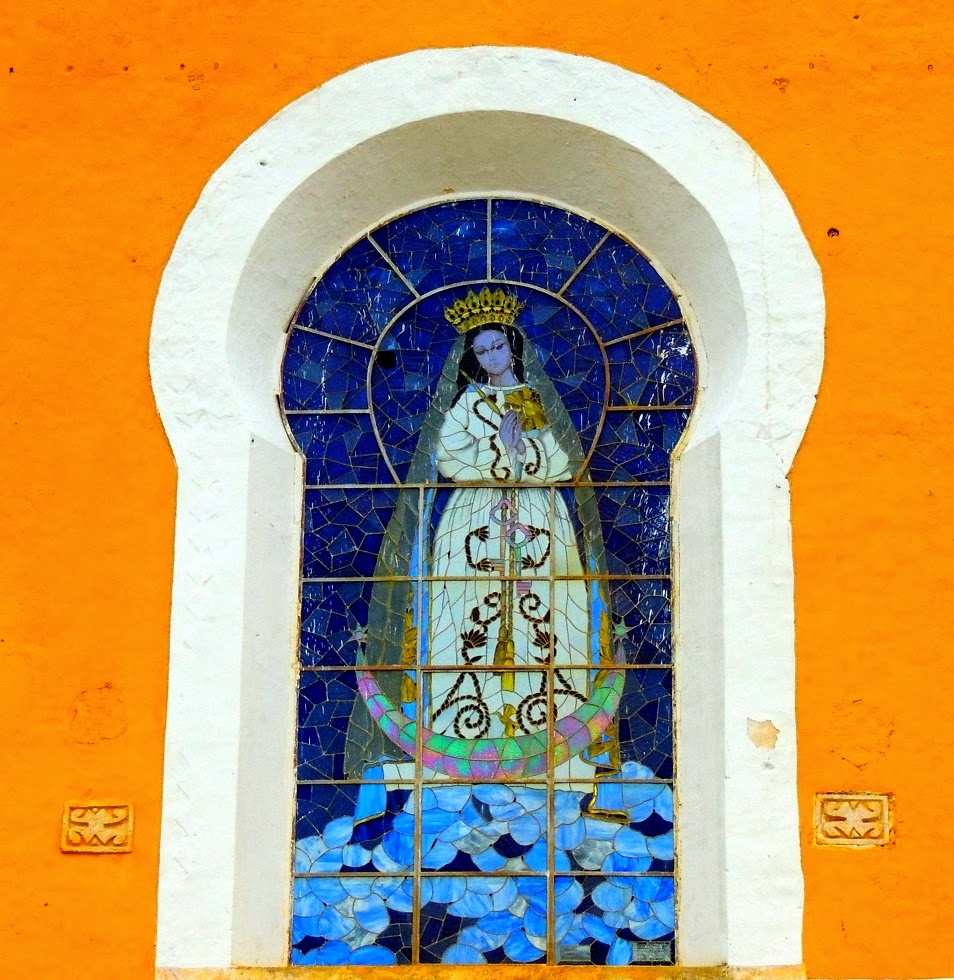
Stained glass window, Izamal
When asked, Sylvia, the iPhone politely informed us we were headed in the wrong direction. She then dispensed step-by-step instructions for multiple turns onto tiny one-way roads, including exactly how many meters before our next turn onto yet another dust-covered alley, wending our way to the intersection of the highway. 
 I take back every sarcastic comment I have ever made about people relying on GPS! Sylvia, the iPhone is a very knowledgeable lady.
Valladolid in the evening
Getting into the centre of Valladolid was easy; we had been there many times and we had good instructions – the pen and paper kind – for finding our hotel. The Casa Tia Micha is a tiny B&B a few steps off the square. With a total of three guest rooms available is probably the tiniest hotel that we have ever booked. The front entrance is quite plain, with a black metal gate opening up to a delightful entrance and courtyard. The B&B is beautifully decorated with great attention to detail; comfy beds, good showers, a complimentary bottle of wine and two nice wine glasses. Just perfect!
Our room at Casa Tia Miche, Valladolid
In the morning, co-owner Rosanelly Ayora Sosa treated us to a tasty three-course breakfast of regional dishes, a great start for our day of roaming the Mayan ruins of Chichén Itzá. Settled in around 600 CE and abandoned in the late 1500s, Chichén Itzá was rediscovered by European explorers in 1842. The entire complex was buried under an accumulation of trees, vines, and other assorted vegetation that had grown unchecked. By 1923, the Mexican government was interested in excavating the main parts of the city. Excavation projects are ongoing at the site as more structures have been located, some buried underground, some deep in the jungle.
Our travel partners - Maia and John at Chichén Itzá
We arrived at the complex around 9:30 in the morning. We had three hours of relative peace - to take photos, read information plaques, cruise past the hundreds of vendors and leave before the dozens of tour buses from Cancun, Playa del Carmen, and Mérida disgorged their sunbaked passengers.
Turning back to Valladolid, we headed to our other favourite restaurant, the Taberna de Los Frailes, for a late lunch. Serving tasty regional specialties, the Taberna is a great place to relax and enjoy time with family and friends. The eatery is located in a sub-district of Valladolid called Sisal, beside the Convento of San Bernardino de Siena. The Convento (monastery) was built between 1552 to 1560 by the Franciscan monks and was in use until 1755, when it was abandoned. A self-guided tour of the property is a good way to walk off a few lunch calories.

San Bernardino de Siena
Early the following morning, we enjoyed our last tasty breakfast before setting off on our return trip to Isla Mujeres. We decided to drive the “libre” road, the toll-free, slower route, and more interesting than a four-lane, dead-straight, nothing-to-see route.


TriciTaxis - Leona Vicario
We bumped our way over the topes (speed bumps) of each small village, passing plant nurseries, handicraft stands and small restaurants. In Leona Vicario, we were surprised to see motorcycle-based TriciTaxis, buzzing around, carrying students to and from school, shoppers, supplies – anything. Cool idea!

Casa Tia Miche, Valladolid

And then finally we were headed home on the car ferry, content, tired, and ready to chill out for a few days in our island paradise.
We love road trips! And we really love getting back to our home.

Friday, October 19, 2012

Wood-fired corn tortillas – little cakes!

Restaurante Kinich in Izamel, Mexico.
Soft words float in the semi-dark hut, curling towards the ceiling with the drifting wood smoke. A gentle rhythmic sound filters between the words: pat-pat. Pat-pat.  Pat. 

Perched on small stools near a low, wood-burning fire, three dark-haired women chat amiably while they hand-make corn tortillas. 

Is this a scene from a previous century?  No. It is present day at the Restaurante Kinich, one of our favourite places to eat when we are in the pretty colonial City of Izamal. There is nothing like fresh corn tortillas, hot off the griddle! Tasty!
 
In Mexico, the dietary mainstay of most families is the tortilla made from corn, white maize.  The national average consumption per person in Mexico is 120 kilos, or around 264 pounds of tortillas per year; presumably, adults consume more than the national average, babies and toddlers considerably less. The versatility of this popular food is endless. They are used for tacos, flautas, burritos, and enchiladas, used as utensils to scoop up food, and, when necessary, used as a small plate. 


My sister Valdine in 2008 at Tortilladoras near our house
When we first moved to Isla Mujeres, there were several tortilladoras scattered around the island neighbourhoods, making fresh tortillas every morning. By seven in the morning, the delivery boys could be heard honking their bicycle horns, advertising the fresh hot tortillas. 

My sister Joann, who lives on Isla during the summer, likes to purchase from one of the smaller establishments two or three tortillas at a time - completely confounding the clerks. 
Sister Joann in the new Chedraui Store

“How much do we charge?” They wonder.

Eventually, Joann decided to buy the normal amount and give the unwanted remainder to someone else to enjoy. I’m sure they still chuckle about the “Crazy Gringa.”

With the arrival of the large Chedraui Super Store on the island, we were concerned that the smaller establishments would disappear. 

A year down the road, and they all seem to be doing well, even though Chedraui sells a kilo of tortillas slightly cheaper than the government-subsidized rate.


In the very traditional method of making tortillas, the corn kernels are cooked with lime to remove the husk and then ground on a stone slab, a metate, with a grinding stone, a mano. Next, a little water is added until a soft dough is created.   Once the texture is perfect, a golf ball-sized portion of masa harina dough is shaped into a flat, thin pancake about six inches in diameter. Then it is placed onto a hot griddle or a wood-heated comal to be quickly cooked on both sides.  

In the commercial tortilladoras, the pre-processed grain is purchased in large sacks, often truckloads at a time. The corn flour is treated with calcium hydroxide to release the niacin in the corn and to make it easier to digest. The dough is quickly stamped into thin circles with a machine, and a conveyor belt takes the tortillas to be cooked over a gas flame. Efficient! And still very tasty.
 
However, the best tasting tortillas are the ones cooked over a wood fire – like at Restaurante Kinich. 

But if you have ever eaten at Deysi and Raul’s El Charco Restaurante on the island, you have eaten fresh corn tortillas made to order by Raul. 

Pretty darn tasty too!
 
 
                Grab your copy today!

Or


Monday, October 24, 2011

Road Trip to Izamal in the Yucatan Peninsula, Mexico!

We love road trips, short or long, it doesn’t matter.  It’s all about the adventure.  One of our favourite road trips is to a small Spanish colonial town - Izamal - between Cancun and Mérida.
Monastery under restoration.   
The easiest way to reach Izamal is by driving up the four-lane toll highway 180D from Cancun.  The first time we visited Izamal, we turned at the exit that is closer to Mérida. The next time, we turned off at the exit closer to Valladolid, which made for an interesting trip along a narrow winding road, through three very small pueblos: Kantunil, Sudzal, and Juan Pablo.

We were the subject of much curiosity and gawking as our Canadian car slowly navigated the “topes” (speed bumps) and narrow, shoulder-less roadway.  I'm sure our friends were convinced we had absolutely no idea where we were headed as we squinted at the windshield, muttering, "I don't remember this. I don't remember any of this." We just hadn't realized that there were two different exits off the main highway.

Marketplace in the centre of Izamal
Eventually, we arrived at the centre of Izamal, a lovely little town settled in the early 1540s by the Spanish. During the time of the Spanish conquest of Yucatan (1527-1547), Izamal was one of the largest and most beautiful cities on the peninsula. The city was considered by the Mayans to be the home of Kinich Kakmo, a manifestation of the sun god, and of the god Itzam Na. Following the capture of Izamal by the Spanish, the local population was ordered to dismantle the top of the enormous pyramid in the center of the city. Upon the flattened pyramid, at the place where previously had stood the sanctuary of the god Itzam Na, the inhabitants were then directed to erect the new monastery and the church. 

For decades, many of the buildings, including the market, colonial buildings and the monastery, have been painted a lovely golden egg-yolk colour. The cobblestone streets, the iron lamp posts, and the clippity-clop of horse-drawn carriages give the town a tranquil old-time ambiance. The site is undergoing a massive restoration with state, federal, and UNESCO money.

Our car, and a horse-drawn carriage at Kinich temple
After visiting the monastery, we decided to find a restaurant in Izamal for lunch, as the drive back to the bigger city of Valladolid would take about another 45 minutes, and we were starving. We happened upon the only sign that we could see that said restaurante. 

Wow! Was it cool! The Restaurante Kinich (named after the Mayan Sun God Kinich Kak Mo) is about a block off the city square, with a pretty entrance and a large, cool, palapa-covered interior.  Delicious smells wafted out of the kitchen. Inside the restaurant was a smaller hut with three traditionally dressed Mayan ladies sitting on large rocks, hand-making tortillas over a very hot wood-burning fire. The food was fabulous.  It has become our favourite place to have lunch on our road trips to Izamal. 

Ladies making tortillas inside Restaurante Kinich
After lunch (with much discussion about directions between my navigator and me) we decided to try and find the Kinich Kak Mo temple ruins. We drove around and around this very small town, only to discover that the temple was right next to the Restaurante Kinich, where we had had our fabulous lunch!  It turns out that my navigator was right all along, and I once again was 180 degrees out on my directions! (Okay, I said it! You were right!)

We have returned to Izamal several times with friends, and every time it is just as enjoyable as the first time.  Road trips!  Love 'em.

Restaurante Kinich - our favourite place!
Hasta Luego
Lynda and Lawrie

The humble beginnings and true life tale of Sparky, hero of the Isla Mujeres Mystery Series: Chapter 8

Sparky, my decorated golf cart. Chapter 8 It’s Christmas! “ ¡Feliz Navidad! said Driver. “Merry Christmas, everyone,” Servant said, an...