Showing posts with label driving in Mexico. Show all posts

Friday, September 23, 2016

Ex-pats in Mexico – it’s the little differences

Playa Norte, Isla Mujeres
There’s a hugely popular website called expat.com that specializes in communication between people who are scattered around the world, not living in their own country. This week, the discussion topic was: ‘How do you cope with being homesick?’  That’s when we realized we aren’t actually homesick for our country, but we are occasionally still a little discombobulated by the differences.


Beautiful shoes are important
Most of us realize before we leave our home country that there will be some big changes to our lives, but it’s the little differences that can catch you by surprise.

·       Mexico uses the metric system.  No inches, feet, miles, ounces, pounds, or Fahrenheit. Yes, we are Canadian and our country switched over to metric in the mid-seventies to match the rest of the world, but in school, we learned the Imperial measurements. Change happens more slowly when you are older. Buying shoes in metric is still perplexing, but most everything else has sorted itself out in our brains.  We can only imagine how confusing it is to our American neighbours, the last country in the world still using Imperial measurements.

We are still too early for everything!
·      Appointment times are all-ish. If four in the afternoon is when you are meeting a friend, or expecting a service person, that is now four-ish. Your acquaintance or tradesperson could be thirty minutes, an hour, or two hours late. It’s not rude, it’s just the way it is.  The person will eventually arrive, all smiles and hugs or handshakes. Life is good; they are very happy to see you, and therefore it follows that you are very happy to see them. 

    Public events, parades, parties – everything is ish! When we first moved here, we always arrived at the suggested time, only to find the host in the shower and the hostess decorating for the party.  It’s a little less embarrassing now that we don’t arrive exactly on time.
Buy fresh.  Buy often.

·       Street closures are common, especially in the smaller communities. Why?  Usually, for a family event, such as a funeral or a birthday party. Most of the homes are too small for family gatherings, and permission is usually granted to close the street for several hours. No one gets upset; everyone just adjusts their schedule to work around the closure. 

·       Grocery shopping is a daily task for most locals, and we have changed from our Canadian habit of stockpiling once a week to shopping every other day. The produce is fresh, ripe, and doesn’t keep for any length of time. Buy fresh, and buy often is the local habit. 


Driving in Mexico is entertaining.
·     Signs for small businesses are somewhat limited.  When asking for directions to an unfamiliar store or business, it’s always best to ask for a description of the building, including colour. Many small establishments don’t have signs.  The reasoning is, if you are a resident, you know the location.

·       Driving in Mexico is entertaining, especially in the bigger cities. The local drivers are very aware of traffic around them and are pretty decent drivers. The incentive to stay out of accidents is huge. Get into a fender-bender, and everyone goes to jail until the police decide on who is responsible and who is paying.  Signs and traffic lights are treated as ‘suggestions’, not cast in stone, the exception being the raised striped crosswalks. Traverse one of those when pedestrians are using the crosswalk, and you will rapidly find yourself having a lengthy personal chat with a police officer.  Been there.  Done that.  
 
My alter-ego with a policewoman
·      And speaking of the police.  When we moved here, we were told by many Mexican friends, Do not ever interact with the police.  Don’t make eye contact or even smile at them. We did that for several years, and then decided that we weren’t happy treating other human beings this way. We’ve started to acknowledge the officers with a wave and a smile. They wave, smile back, and chat when they recognize us. 

·      As for guns, contrary to what international television news suggests, guns are very, very rare in Mexico. 

In In fact, there is only one store in all of Mexico that sells guns, and you would not believe the paperwork. 
·    

   
Immigration in Cancun, lineups out the door. 
Bureaucracy is a fine art in Mexico.  Paperwork takes an inordinately long time to process, whether it is immigration papers, building permits, or simply renewing a driver’s license.  Bureaucrats will test your patience. It’s a good time to practice the fine art of daydreaming as you loiter in the waiting room, linger in the line-up, or shuffle from paper-pusher to cashier and back again. And smile. Angry outbursts will guarantee that your documents find a new home at the bottom of the one-meter-high teetering pile of paperwork, waiting for the final stamp of approval. 


·      And the best difference we have noticed, we can actually wave and say ‘hello’ to little kids. The families are close-knit and loving. It is everyone’s job to watch out for the younger family members, but a wave and a smile are still allowed. It’s a refreshing change.

As Expats, living in a foreign country has been very beneficial to us.  We have been able to stop medications for stress and high blood pressure.  We seldom eat packaged or prepared foods.  We are happy and healthy. 

We aren’t homesick; this country is our home.

Hasta Pronto!

Lynda, Lawrie, Sparky, and Thomas the Cat

Or 


Friday, May 20, 2016

Topes – the speed bumps of life in Mexico


Police and raised tope on Rueda Medina in Centro
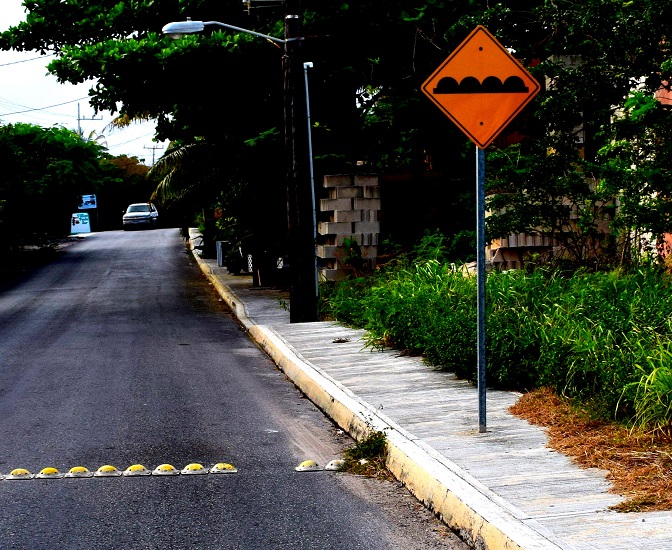
Topes, the ever-present driving hazards in Mexico, are actually speed bumps designed to modify the Formula-1 habits of local drivers. Topes come in many shapes and sizes. They are annoying. Necessary but annoying.
There are the raised yellow-and-white striped crosswalks, one of the few places in Mexico where pedestrians have the right of way. These are usually near schools or busy areas, such as the original exit from the passenger ferry terminal on Isla Mujeres. These topes are controlled by traffic police using hand gestures and the sharp notes of a whistle to snag the attention of drivers distracted by Smartphones, selfie sticks, or bikini-clad tourists. Afternoons on Rueda Medina can be bedlam with visitors disgorging from tour boats and passenger ferries. The combination of well-marked crosswalks and traffic police reduces the number of close encounters of the painful kind between people and vehicles.

Topes slow the speeders down - a little
Then there are the normal topes, the narrow, recycled-rubber contraptions that are bolted to the pavement. 
These hard bits of latex can give drivers a nice back-shaking jolt when crossing. The good thing about this style of tope is that they are visible even on rainy nights as their distinctive yellow and black stripes are part of the rubber compound, not just painted on the surface. 

Hand-made tope sign on the right
A nasty, unpainted bump is located on the south-western side of the island, near the horse coral, and across the street from the construction site for a new house. Rubber-necking the progress of the new-build is guaranteed to give you a sharp thump of surprise when driving on this stretch of road. I’ve done it so many times, the construction crew cheers when I actually remember to slow down and traverse the tope at a crawl. Driving past the crew this morning, they pointed at a recently installed handmade tope warning sign.  That was good for a chuckle and a photo.

Moto pathway through tope
In that same stretch of road near the never-completed Unik Hotel (Unique) is a series of half-sphere metal bumps.  There is no easy way to cross these teeth-rattling orbs, unless you happen to be riding a moto. 
Someone has thoughtfully removed a bump, one on each side of the road, creating a pathway for a narrow wheel.  
Experienced moto riders give a little hip waggle, dodging to the right and then left, whizzing away.

Our Mini scrapes on this one
There are two extra high topes on the island that cause our low-slung Mini Cooper a bit of navigational difficulty.  One is the muffler-scraping lump in Centro on Matamoros just west of Olivia’s Restaurante
With two people and one small dog in the car, it’s a slow crawl for us, taken at a forty-five-degree angle to get over the steep-sided speedbump. When we have friends with us in the car, we don’t drive on that block of Matamoros. The other problem tope for our car is near the bakery in the Salinas Grande neighbourhood.  It’s a slow and noisy scrap over that one as well.
Moto slowing for unmarked and unpainted tope
But our absolute least favourite type of tope is the raised bump in the pavement: black and invisible. The sharp bump will rattle your back teeth if you don’t have all the topes mapped out in your head. These are the sneaky gotchas, where the original yellow cautionary paint has been worn away by vehicle tires and rainstorms. The once visible metal warning signs are typically victims of rust and corrosion, either lying on the ground or missing entirely. The southbound lane of the double-wide Passeo de Aves, near the YZA Farmica, has one of these invisible lumps. No sign.  No paint.  You have to rely on your memory, or not!
Snoozing in paradise
And, there are the warm and fuzzy topes: sleeping dogs. Snoozing on a warm street is a favourite pastime for local pooches.  
Keep your eyes peeled for these guys.  They are just enjoying a nap on their little piece of island paradise. 
Hasta Luego

Lynda, Lawrie, and Sparky


Or


Friday, August 21, 2015

Driving in Mexico – It’s like a video game!

Driving in Mexico is a bit like a video game, a test of your reflexes and hand-eye coordination.  
It can be entertaining and fun, if not a little bit nerve-wracking.  
The traffic is fast, signals or stop signs are merely suggestions and staying in one lane isn’t always the safest choice.  
Ya gotta keep your eyes open and go with the flow.  Don’t drive too fast.  Don’t drive too slowly.  Just go with the flow.  

Little or no warning - road closed.  Turn here!
Lanes narrow, or disappear without much notice.  Road work can appear suddenly without a lot of warning signs.  A typical construction zone might have one lonely worker waving a tattered piece of red cloth as you are about to run over him.  Watch out!  

And at the end of the workday, an assortment of graders, rollers, and vehicles are parked on the dark roadside, with no flashing lights or warning signs. 


End of the day park the equipment and go home.
On the highways, cars, vans, or trucks pass anywhere it is possible to squeak by.  Recently, on Isla, we were driving south on Aeropuerto Road, just starting up the little hill near Casa Cielo, when the taxi behind, and the taxi behind the north-bound vehicle both decided to pass at the same time.  It’s an amazing feat of physics, or perhaps time and space, when four vehicles can pass without incident on a narrow two-lane strip of road. 


We drive a golf cart as our everyday vehicle. It's fun and easy, but basic on standard equipment. An island turn signal is your arm stuck out to the left to indicate you are turning left, or maybe to tell the driver behind you it’s okay to pass, or sometimes to tell the driver ahead that you are going to overtake him/her.  Your right hand pointing to the right is usually the indication that you are turning that direction, or perhaps just resting your arm on the back of the seat. 

Recently, we were on a short and busy trip back to Canada.  We rented an average car, complete with standard safety equipment such as brake lights, seat belts, and airbags.  I enjoy driving and hopped into the driver’s side of the Hyundai Sonata.  Coming up to our first turn, I indicated with my left arm that I was turning left and slammed my hand into the closed window. Oh, right. This car has turn signals. All was well for a few more miles until I had a momentary glitch in my brain’s hard drive, and signaled right by slapping Lawrie in the face with my right hand. 

Internet - standard hand signal for right turn
I must admit we get a bit of perverse pleasure in confounding our Mexican friends when we use our left arm, bent at a ninety-degree angle, to indicate a right turn.  It’s the standard signal in most parts of the world …. just not here.   

Other drivers give us a “what the heck are you doing?” look, which makes us smile.  Small things amuse us!


Typical street in rural Mexico
In Mexico, pedestrians do not have the right of way, as they do in the USA or Canada.  

However, those wide yellow speed bumps (topes) are sacred!  They are typically located in extremely busy locations, such as across from the passenger ferry terminal, near the schools, and at the Chedraui grocery store.  

DO NOT drive through these crosswalks while a pedestrian is crossing.  This is the quickest way to irritate the police, and for you to donate cash to the Policemen’s Benevolent Society. 

Good luck with your new video game: Driving in Mexico
Hasta luego, Lynda, Lawrie, Sparky, and Thomas


Juarez Avenue at sunset on Isla Mujeres
Grab your copy today!

Or


Friday, January 11, 2013

Express yourself with a carrito de golf, Isla Mujeres, Mexico

Santa Claus parade 2012
Dozens of wrapped candies tossed by giggling children litter the roadway in front of our house. 

Steelers fan!
Our two grandsons madly scooped up the candies, catching them mid-air, or zipping between vehicles before the goodies were squished under a wheel.  


Accompanied by many honking horns (or is it horns-a-honking?), a flotilla of vehicles passes by our house.  

In a parade, there will inevitably be many golf carts overflowing with passengers who wave and toss treats to enthusiastic observers. These are privately owned golf carts, painted, decorated and accessorized to express the owners’ offbeat personalities.  

Some of our friends have decorated their personal golf carts with the logos of their favourite sports teams, or flashy chrome hubcaps, or a variety of flags. Many locals have retrofitted their carts with plastic roll-down side curtains to protect them from tropical rainstorms.

Great decorating job!
One American friend has a very charming carrito de golf.  It is upholstered in vibrant orange and painted fluorescent pink, matching the exterior of her eye-catching house.  

For Christmas, she added garlands, bows and ribbons, making her golf cart one of the prettiest on the island.  

Other friends were over-the-top with their holiday decorations, adding ornaments, wreaths, tinsel, strings of garland and pearls, reindeer antlers and even solar-powered lights.  


We left a trail of broken ornaments around the island.

When the grandsons were visiting, we borrowed a riotously decorated golf cart for a few days.  

We entertained a lot of people, leaving a trail of shattering glass ornaments as we were buffeted by north winds, or we thumped over speed bumps.   

Golf carts are legal to drive on the public roadways of both Isla Mujeres and nearby Isla Holbox. There are several golf cart rental outlets on the island where tourists can rent golf carts tricked out in camouflage, or as a 1957 Chevy, or a Jeep Wrangler, or even a fire truck.  

Not the way to drive a golf cart
And yes, this is a tropical island, and yes, you are on holiday, but letting an underage child drive a golf cart is a disaster waiting to happen. 

There are ambulances, fire trucks, police vehicles, propane trucks, or tractor-trailer units, plus hundreds of taxis, golf carts, motorcycles and bicycles all vying for limited road space. You are unnecessarily risking not only your own safety but also the safety and livelihood of the other drivers. 

More friends decked out for the holidays!
Quite recently, licensing a personal golf cart on Isla Mujeres has become almost impossible as the taxi drivers keep up the pressure on both the state and municipal governments to restrict the number of licenses available. 

But, whether you rent one for the day, or own one for your personal use, the one thing the golf carts of Isla are not used for - puttering around a golf course. There are no golf courses on Isla. 

No matter, you can still have a great time driving a carrito de golf that expresses your individual personality while circumnavigating a beautiful little Caribbean island.

Hasta luego, Lynda & Lawrie

Friday, September 14, 2012

Morelia, Mexico: an unexpected, delightful detour!


Dormant volcano
Cruising along two hundred kilometres south of Guadalajara, on the #15 multi-lane toll highway, the surrounding land is fertile, richly coloured. 

Numerous dormant volcanic mountains tower in the distance, their peaks obscured by low clouds. The earth resembles grated cinnamon, unsweetened dark chocolate, and freshly ground coffee. 

And the air smells of burning oil.  That can’t be good.
 

We turn off the road at a highway service area into the PeMex station, and shut off the truck. Burning oil, dripping from an engine gasket onto the hot exhaust pipe. The gas jockeys gather around the truck, offering suggestions in Spanish and pointing. Lawrie has a pretty good idea of the problem. We add a litre of oil, and buy two more as a backup. We decide to turn back, at least as far as the previous highway exit, to a place called Morelia.

Morelia Centro
Our first turn-back opportunity is at a toll booth populated with a dozen or so State Police. I’m driving. I power down the window and sputter a few words, hopefully explaining that the truck is broken. Camioneta rota. Regreso a Morelia.” 

It works. They laugh. Smile. And let us do a U-turn on the highway, picking up the traffic cones, waving us through, joking about the smoke pouring out from under the truck.  

Not the usual reaction we have had with Mexican State Police in our home state of Quintana Roo. (Perhaps I mistakenly said that his stilettos were pretty? Or that he had peanut butter stuck to his eyebrow?”)

Service Manager David and Lawrie discussing Sport Trac
We make our way to Morelia and ask the local police how to find the Ford Dealership. More smiles. Shoulder shrugs. And then a passerby helps out.  “Straight ahead, through town, and it’s on the left.” Easy! Sure.

Morelia is a big, beautiful city of around four million inhabitants, and that day, the main street was closed due to an accident.  


Morelia Centro on Saturday night
We spent the next hour trying to find our way around the various hilly side streets, following first one taxi then another. I pulled over at a little vehicle repair shop and asked for help; more directions in Spanish, and a hand-drawn map. 

As I got back into the truck, the shop owner’s son pulled up beside me on his motorcycle. “Follow me!” He zipped along back streets, one-way streets, and tight corners, and then we were there. He waved off our offer of a tip for his efforts.  Just smiled and waved. Gone.

We are now completely captivated by the City of Morelia.  Beautiful and friendly. 

David, the Ford Dealership Service Department manager, was very helpful, but it was Saturday, and they had already closed the service department for the day. All the mechanics had finished work at two in the afternoon, and were done until nine in the morning on Monday. There was nothing for us to do but find a decent hotel for a couple of nights and explore the city. David handed our taxi driver a Ford Service Department coupon for a complimentary taxi ride to a hotel. He suggested the Alameda Hotel, near the gorgeous cathedral in Centro. It was an interesting hotel, composed of three old hacienda-style buildings. The sturdy stone walls made the hotel rooms extremely quiet and cool.

Musicians in Morelia Centro Saturday night
Saturday night, Centro was buzzing with people. People gathered in the cathedral square to watch entertainers, chat with friends, or enjoy a drink in a sidewalk café. It was fascinating. We spent the next two days exploring the city on foot and by tour bus. 

Originally settled in the 7th century, the city was later settled by the Spanish in 1525 and renamed Valladolid in 1541. The name was later changed to Morelia in 1828, to honour a local hero, José Maria Morelos Y Pavón, for his part in the War of Independence from Spain.

Sunday morning mayhem in Centro Morelia
Sunday morning, we stepped outside of our hotel to be confronted by an odd sight; dozens of people riding bicycles, children on plastic pedal cars, teenagers on roller blades with dogs running along beside. Not a car in sight. We wandered, snapping photographs and exploring side streets. 

By Monday we were anxious to make a decision on the truck: repair, or not. We returned to the Ford Service Department.  A part was required, but it could take two or more weeks. David said we could drive the vehicle as long as we checked the oil frequently.  Lawrie asked them to balance the front tires, and said we would be back in the morning to get the truck.

One of dozens of shoe shine stands in Centro
Lawrie made a phone call to the company in California that supplied and imported the Sport Trac for us. They apologized profusely. They suggested we could either leave it in Morelia or, if we wanted, we could drive it back to Guadalajara and leave it with their representative there. They would find us a better vehicle, quickly. 

In the meantime, on our last night in Morelia, Lawrie happened upon a nearby restaurant that had great reviews on the internet: Casa Grande. We decided to treat ourselves to a good dinner.  It wasn’t just good, it was fabulous! Appetizers, rack of lamb, dessert, and wine, the total bill was around 80 dollars.  It was our tastiest dinner out in four years, including our recent trip to France and Italy. 

Roof top view at Casa Grande Restaurante in Morelia
Leaving Morelia on Tuesday morning, we had an interesting drive through the scenic secondary roads back to Guadalajara, and back to our original hotel. We flew home to Isla on Wednesday.

We’ll continue our cross-country adventure at a later date, including a one-night return to the lovely City of Morelia. 

It was an unexpected, delightful detour.

Hasta pronto

The humble beginnings and true life tale of Sparky, hero of the Isla Mujeres Mystery Series: Chapter 8

Sparky, my decorated golf cart. Chapter 8 It’s Christmas! “ ¡Feliz Navidad! said Driver. “Merry Christmas, everyone,” Servant said, an...