
 |
| Centro Izamal Yucatan, Mexico |
“I
wonder if Sylvia
knows where we are?” I joked as we turned down yet another tiny,
unmarked street in the colonial town of Izamal.
I was referring to John's iPhone GPS. We were looking for the route back to Highway #185 and Valladolid.
I was referring to John's iPhone GPS. We were looking for the route back to Highway #185 and Valladolid.
 |
| Franciscan monastery in Izamal |
About
a three-hour drive from Cancun, Izamal is one of our favourite places
in the Yucatan Peninsula to take visitors. Settled in the 1540s by the Spanish, the city and the Franciscan monastery were built
directly on top of an old Mayan temple. The monastery and many of
the buildings in Centro have traditionally been painted a mellow
egg-yolk gold. Even though the reason for the monochromatic hue has
been lost over the decades, the golden colour gives a lively, vibrant
look to photographs.
 |
| Our favourite Kinich Restaurante |
Lawrie
and I typically travel with maps, but since we have been to Izamal a
few times in past years, we thought we knew where we were going, and
he normally has a fine-tuned sense of direction. However, when
driving on roads that wind through cramped, narrow streets on flat, featureless land, the topography looks the same all the time.
Full from a spectacular lunch at our favourite eatery in Izamal, the
Kinich Restaurante, we were a bit drowsy and probably missed the rare
and sun-faded directional signs. So, John and his iPhone came to our
rescue!
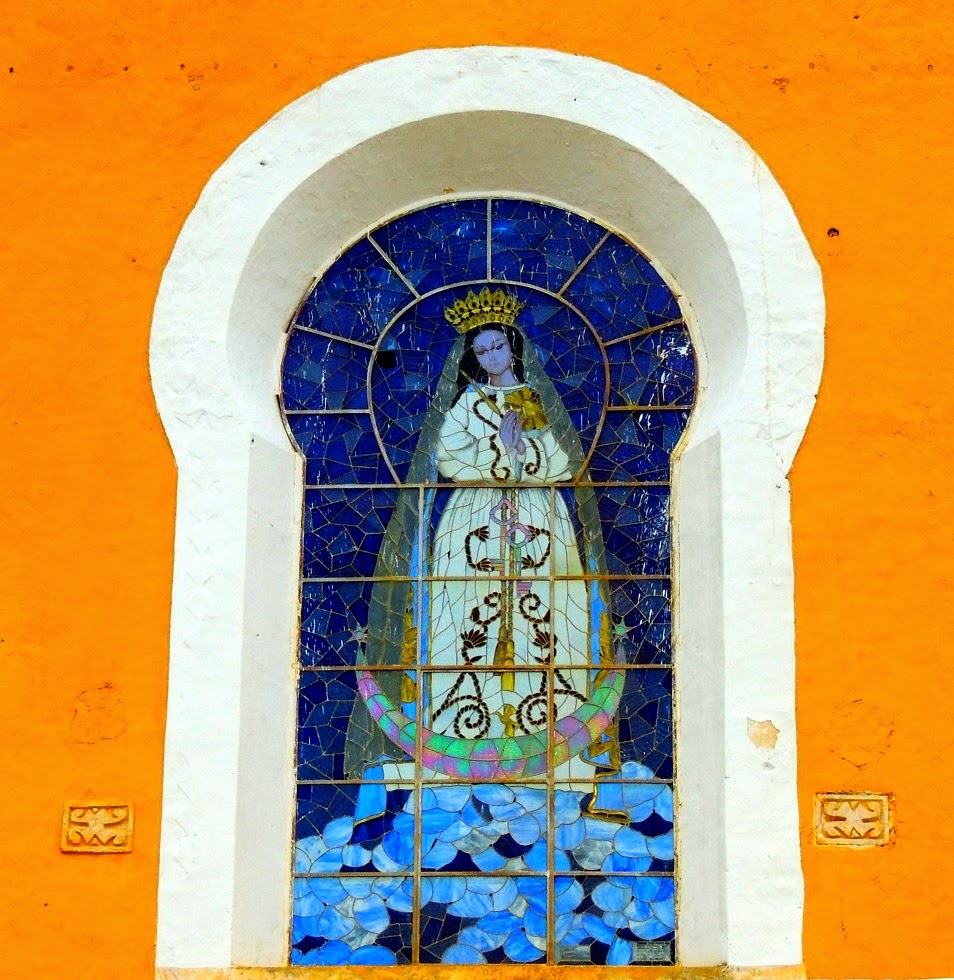 |
| Stained glass window, Izamal |
When
asked,
Sylvia, the iPhone
politely informed us we were headed in the wrong direction. She then
dispensed step-by-step instructions for multiple turns onto tiny
one-way roads, including exactly how many meters before our next turn
onto yet another dust-covered alley, wending our way to the
intersection of the highway.
I take back every sarcastic comment I
have ever made about people relying on GPS! Sylvia, the iPhone
is a very knowledgeable lady.
 |
| Valladolid in the evening |
Getting
into the centre of Valladolid was easy; we had been there many times
and we had good instructions – the pen and paper kind – for
finding our hotel. The Casa Tia Micha is a tiny B&B a few steps
off the square. With a total of three guest rooms available is
probably the tiniest hotel that we have ever booked. The front
entrance is quite plain, with a black metal gate opening up to a
delightful entrance and courtyard. The B&B is beautifully
decorated with great attention to detail; comfy beds, good showers, a
complimentary bottle of wine and two nice wine glasses. Just
perfect!
 |
| Our room at Casa Tia Miche, Valladolid |
In
the morning, co-owner Rosanelly Ayora Sosa treated us to a tasty
three-course breakfast of regional dishes, a great start for our day
of roaming the Mayan ruins of Chichén
Itzá.
Settled in around 600 CE and abandoned in the late 1500s, Chichén
Itzá
was rediscovered by European explorers in 1842. The entire complex was buried under
an accumulation of trees, vines, and other assorted vegetation that
had grown unchecked. By 1923, the Mexican government was interested
in excavating the main parts of the city. Excavation projects are
ongoing at the site as more structures have been located, some
buried underground, some deep in the jungle.
 |
| Our travel partners - Maia and John at Chichén Itzá |
We
arrived at the complex around 9:30 in the morning. We had three
hours of relative peace - to take photos, read information plaques,
cruise past the hundreds of vendors and leave before the dozens of
tour buses from Cancun, Playa del Carmen, and Mérida disgorged their
sunbaked passengers.
 |
| Taberna de Los Frailes Valladolid |
Turning
back to Valladolid, we headed to our other favourite restaurant, the
Taberna
de Los Frailes, for
a late lunch.
Serving tasty regional specialties, the Taberna is a great place to
relax and enjoy time with family and friends. The eatery is located
in a sub-district of Valladolid called Sisal, beside the Convento
of San Bernardino de Siena. The Convento (monastery) was built
between 1552 to 1560 by the Franciscan monks and was in use until 1755, when it was abandoned. A self-guided tour of the property is a good
way to walk off a few lunch calories.
Early
the following morning, we enjoyed our last tasty breakfast before
setting off on our return trip to Isla Mujeres. We decided to drive
the “libre” road, the toll-free, slower route, and more
interesting than a four-lane, dead-straight, nothing-to-see route.
We bumped our way over the topes
(speed bumps) of each small village, passing plant nurseries,
handicraft stands and small restaurants. In Leona Vicario, we were
surprised to see motorcycle-based TriciTaxis, buzzing around,
carrying students to and from school, shoppers, supplies –
anything. Cool idea!
 |
| San Bernardino de Siena |
 |
| TriciTaxis - Leona Vicario |
 |
| Casa Tia Miche, Valladolid |
And then finally we
were headed home on the car ferry, content, tired, and ready to chill
out for a few days in our island paradise.
We love road trips! And we really love getting back to our home.
Hasta Luego
Lynda, Lawrie, Sparky, and Thomas the Cat


