Friday, September 2, 2016

Bonnie and Ariel the faces behind Sea Hawk Dive Shop & Suites

Ariel - a few years ago
“Do you ever take a day off?”  I asked Bonnie Hamilton early on a Sunday morning last week. 
She flashed her high-wattage smile and said, “In hurricane season,” which probably meant, we do if it is raining like hell and the weather is too rough for our boats; otherwise, no, we don’t take a day off.  
   
Bonnie Hamilton, Ariel Barandica Dec 2015

Well-known islanders Bonnie Hamilton and Ariel Barandica met on Isla Mujeres in 1985, when Ariel was operating his Sea Hawk Dive Shop from the beach near what is now Fenix Restaurante. Every morning, he stuck a colourful umbrella in the sand, and placed a dive tank under the umbrella, then added a sign proclaiming Sea Hawk was open for the day. His boat was either anchored in the bay or tied to the bridge that gives access to what is now the Mia Hotel.

Diver and turtle - photo by Tyto 
Originally from Veracruz, Ariel arrived on Isla Mujeres in the late 1970s. He had been working the oil rigs near Campeche for a few years before deciding the work was too dangerous and there had to be a better way to make a living.  

Ariel originally operated his business from another beachside location at the south end of the island, before it was designated as Garrafon Natural Reef Park.  The snorkeling was outstanding with thousands of nearby fish inhabiting clear blue waters.  By 1981, the reef was beginning to show signs of decay, with too many boats dumping effluent and people carelessly walking on the coral, not realizing how delicate it is. Ariel and friends petitioned the government to protect the reef from abuse.  It’s an ongoing problem.
Eagle Ray - photo by Tyto
Married in 1987, Bonnie and Ariel’s two adult children have dual citizenship - Canadian and Mexican.  
Their son Jerson is an engineer by trade, but an award-winning soccer player by passion.  He learned to play five-a-side futsal on Isla Mujeres, utilizing sand lots, streets, basketball courts, soccer fields, and beaches.  
Any level space would do. He is currently the Head Coach of the Women’s soccer program at the University of Saskatchewan in Canada, and a coach for the White Caps High Performance Academy.  Also well-educated, their daughter Leira enjoys traveling the world and helping out at the dive shop whenever she returns to the island.

Omer & Avital, Israel swim with Whale Sharks
By 1999, Bonnie and Ariel had built their current Sea Hawk Dive Shop & Suites facility on Avenida Carlos Lazo, near the Convention Centre and just a block off North Beach.   Their cozy little hotel has six rooms, allowing guests easy access to snorkeling or diving tours, diving lessons, and trips to swim with the beautiful whale sharks

The cool thing about booking a whale shark swim with Sea Hawk Dive Shop is that they supply wetsuits for all of their customers.  Wearing a wetsuit in place of the mandatory and clumsy life vest provides buoyancy but a lot more flexibility when swimming. 
According to Ariel, here in Mexico, we have the largest congregation of whale sharks in the world, and it is very interesting to compare the prices for a day trip to see these gentle giants.  Australian tour boats charge between $600.00 and $650.00 USD per person per trip, while the tour companies that arrange trips from Playa del Carmen, Mexico, to see the pod that congregates near Isla Mujeres charge between $300.00 and $400.00 USD per person.  If you deal with an island tour boat, the cost is typically $100.00 to $125.00 USD per person.  Shop local!  Save money!
Zephyr & Megan from USA, Roberto & Tyto

Marine biologist Tyto Morales is the dive master, and Roberto Leiva is the boat captain at Sea Hawk Dive Shop. The two guys work hard to make your experience fun and informative. 
A number of the gorgeous photographs on their Facebook page and in this blog article were taken by Tyto.  


Daniele & Assuna, Italy
Bonnie and Ariel are busy, community-minded islanders who donate a lot of time, money, and energy to the betterment of the island. 
When she isn’t working at their businesses, Bonnie might be practicing dance routines for the next Carnaval parade, typically held in February or March, or perhaps teaching yoga in the evenings at NaBalam Hotel
Some evenings, you might find her live-trapping feral cats to be spayed and neutered, in an attempt to keep the island's domestic cat population manageable.  
Anytime you see a cat with a notch out of one ear, it’s a pretty good bet that the cat has paid a visit to the local veterinarian to be altered, compliments of Bonnie and her like-minded friends. It’s a smelly and thankless job, but she is committed to helping out.
Bonnie dancing for 2016 Carnaval 
Next time you want a snorkeling trip, dive on a wreck, learn to dive, or visit during the whale shark season, drop them a note on their Facebook page, or email them at seahawkdivers@hotmail.com – you’ll have a great experience.

Facebook page:
https://www.facebook.com/Sea-Hawk-Divers-144655245615133/?fref=ts
Hasta Pronto!

Lynda, Lawrie, Sparky, & Thomas


Ariel, always smiling!

Or


Friday, August 26, 2016

Why is the Caribbean Sea so blue?

Knock-your-socks-off turquoise!

It’s a knock-your-socks-off turquoise.  An eye-popping azure.  A multitude of shades and hues.  

The first time you see the Caribbean Sea, it usually causes a stunned, jaw-dropping reaction. ‘Oh, my god, that’s beautiful.’


Youngsters enjoying the beach near our casa

So, why is the Caribbean Sea so blue?  We’re not trained scientists, just observers, and we read a lot, and this is our version of the reason. 
The colour of water is controlled by a combination of factors – depth, the floor of the sea, suspended particles (soil and pollution) and plankton. Plankton are those tasty little organisms that are the base of the food chain for the big, hungry ocean creatures. 

1987 north of Puerto Vallarta
Depth – well, generally the deeper the water, the darker the colour due to less reflected light.  
However, in our opinion, the deep water of the Caribbean is a brighter sapphire blue when compared to the light jade green of the Gulf of Mexico in the north, or the deep cobalt blue of the Pacific Ocean on the west coast of Mexico. So what else is going on here?
Sand made of coral and seashells reflects the light 

Well, another big influence for determining water colour is what is on the floor of the ocean. Pale pink or bright white sand made from coral bits and degraded sea shells – mixed in with a few bits of lost pirate treasure - reflects light better than the fine, darker sand found in the cooler waters to the north.  
Then, as we mentioned, the amount of plankton and other particles suspended in the water contributes to the colour.  Phytoplankton, for example, harbours chlorophyll that absorbs red and blue light and reflects green. The more plankton, the greener the water. The Gulf of Mexico also has a high concentration of river silt and fertiliser nutrients, added daily by the rivers draining into the Mississippi River basin. All those bits contribute to the pale green colour.
Isla Holbox in the Gulf of Mexico
Even just a few miles north of Isla Mujeres, you will see a dramatic visual difference between the Gulf of Mexico and the Caribbean Sea. The Gulf of Mexico water surrounding Isla Holbox is light green and filled with plankton and nutrients. The Caribbean Sea water is turquoise and has less plankton. The colourful ocean critters that live in our area have apparently adapted to surviving in an environment low on nutrients.   


View of the Caribbean Sea from Isla 33 condos 

Whatever the reason, the Caribbean Sea is just outright gorgeous. The clarity of the water makes it a diving and snorkelling paradise.  

Or if you prefer a more sedentary form of exercise, hanging out by the water’s edge is a totally relaxing way to spend the day. Staring at the colour, listening to the gentle ‘shush’ of the waves, or immersing in the warm salt liquid.   

Heaven on earth.

Lynda, Lawrie, Sparky, and Thomas the Cat

Hanging out in paradise

Or


Friday, August 19, 2016

One person’s junk is another person’s treasure, Isla Mujeres Mexico

Don Cosi on the wharf near Ballyhoo Restaurant
Early in the morning, while walking Sparky among the cluster of beached fishing boats near the Ballyhoo Restaurant, I noticed an elderly local gentleman sitting on the nearby wharf.  

He was manually crushing a pile of aluminum beverage cans, one by one. 

Heading off to the metal recycler


His nickname is Cosi, and he is apparently in his mid-nineties.  

He told one of the waiters at Ballyhoo that when he was a much younger man, he built wharves. Then, quite recently, his family convinced him to stop doing hard physical work and retire, but he doesn’t like retirement. It’s too boring, so he collects aluminum cans and redeems them for cash. Once he has a bag of cans, he sits on the wharf and crushes them flat.  This enables him to fit more weight in a small area.  

Some of the other can collectors just bag up the cans and transport the whole load via two-wheeled bicycle carts or motos to the recycled metal purchaser. Quicker, but in the end, probably equals the equivalent in weight to what Cosi collects and crushes.

In BC, Canada everything gets sorted!
We asked another of the islanders who collects cans from along the roadway how much a kilo of aluminum was worth in scrap value. He said he is usually paid twelve pesos for approximately seventy-one cans. That’s about .66 cents US for 2.2 pounds of metal. That’s a whole lot of bending over. 

Mexico is not the leader in what we northerners think of as recycling - plastics, glass, newsprint, cardboard, grass clippings, and yard waste - all those things that must be sorted, washed, bundled, or flattened before the garbage crews will remove them once a week from the foot of your driveway.  

In British Columbia, Canada (where we were from), there is a ten-cent deposit on every type of drink container.  

The night before our garbage pickup day, we would leave a box of various containers and bottles at the foot of the driveway - wine, beer, pop, juice boxes, hard liquor - anything. Gone by morning!  It was just easier to leave the returnables for someone who needed the cash than to shift the whole lot over to a recycling depot, sort the stinky mess, and wait in line for the cash refunds. 

Garbagemen separate out the aluminum cans
On Isla Mujeres and elsewhere in Mexico, the roadways are littered with non-returnable glass beer bottles, squashed plastic drink bottles, stray plastic bags, and discarded food wrappers drifting in the wind. There are crews of municipal workers who regularly clean the roadway margins, but it is a back-breaking, never-ending job.

You can help by making it easy for local collectors to find your discarded aluminum adult beverage containers (beer cans!). Collect them in a cardboard box and put them out for the garbage guys. Hotel guests could ask at the front desk and encourage a rudimentary recycling program for the aluminum cans.

Just keep ‘em separate from the rest of your daily trash; somebody will treasure your discards.

Hasta luego, 
Lynda, Lawrie, Sparky, and Thomas

Or


Friday, August 12, 2016

Fine dining on two wheels (Street meats and sweets)

What do I want, what do I want .....
Walking through Centro in the evening can be a sensory experience.  

The smells of cooking hamburgers, hot dogs, tacos, and grilled fish waft through the warm tropical night.  

Followed by scents of hot sugar, cinnamon and warm chocolate.  It’s time to eat!

Mealtimes start early with the mobile fresh orange juice vendor setting up on the corner of Matamoras and Rueda Medina.  Freshly squeezed juice is available until the merchant runs out of oranges.  


Juice man 

The proprietor uses a hand-powered press, pulling down hard with his right hand and biceps to squeeze each individual half.  

He quickly flips the spent portion into a refuse pile, repeating the process until the container is filled with the sweet amber-coloured liquid.   

Judging by the bulging biceps, the juice vendor could easily win any arm-wrestling challenge.

Later in the morning, other mobile vendors arrive to sell cold drinks, flavoured crushed-ice concoctions, popsicles and frozen ice cream treats.  

Choices, choices ......
They set up their carts across from the popular beaches, enticing hot sun-worshipers to purchase a cooling confection.  

It’s a giggle to watch the intense decision-making as youngsters ponder their choices: pineapple, coconut, mango, and chocolate.  

So many flavours. The youngsters turn with inquisitive eyes towards their parents. It’s too hard to decide. Maybe I should have two treats?


The cemetery on Lopez Mateos
Then at sundown, the mobile food peddlers make an appearance, tucking their two-wheeled carts into familiar niches, on street corners at either end of Hidalgo Avenue. The intersection of Lopez Mateos and Hidalgo Avenues, near the entrance to the oldest island cemetery and the IxChel condos, has become a very congested area.  

The vendors vie for their little patch of the pavement, pushing further and further into the street, frequently restricting the vehicular traffic to one lane at a time.  

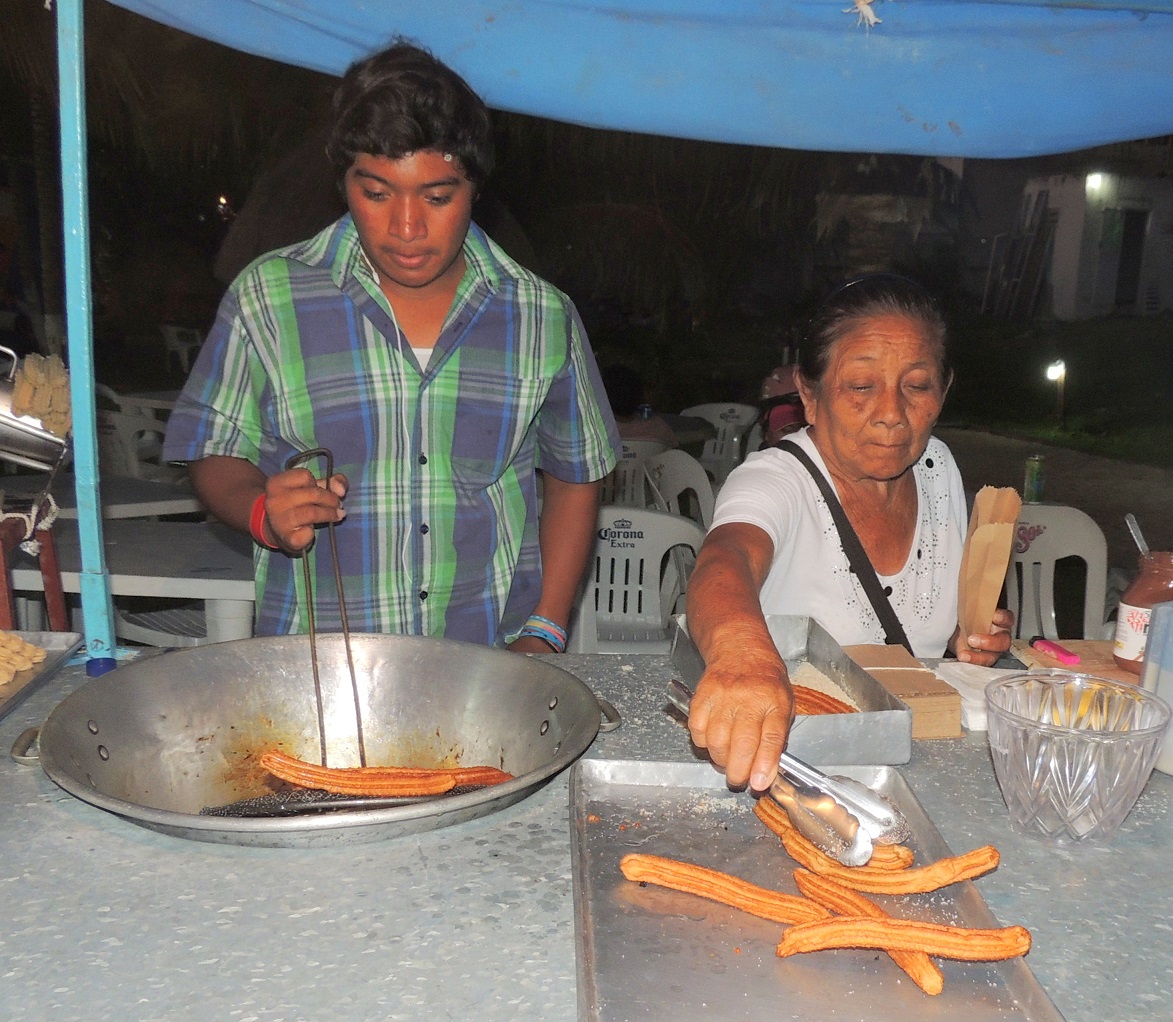
Churros!
A couple of years ago, the city administration decided to prohibit the street vendors from occupying Rueda Medina, limiting their approved location to include this busy corner, and in the square across from the Super X-Press.  

Good idea or bad idea, the jury is still out on that decision.

My favourite street treat is the delicious hot marquesitas filled with chocolate sauce and sliced bananas rolled up with a napkin secured on the end to catch the melting syrup.  


Marquesitas!

Marquesitas are a traditional Yucatan treat, invented in either the late 1930s or early 1940s by Don Vincent Mena Munoz, the heir to the Polito Ice Cream Company. He was looking for a cool weather treat to offset the downturn in ice cream sales during the winter months. 

Similar in texture to a waffle cone, the batter is heated over a hot fire using a cast-iron variation of a waffle pan. The resulting crepe-shaped form can be filled with a combination of ingredients such as Nutella, goat’s milk caramel sauce, chocolate syrup, shredded cheese or sliced bananas. The traditional shape was rolled into a cylinder, but here on Isla it is pretty common to see the cooked waffle mixture folded into quarters. I’m a fan of the rolled shape; it’s easier to cut in half and share.

Juice man headed home at sundown
At the end of a busy day, the vendors head home, back to their neighbourhoods in the centre of the island.  Some of the heavy mobile carts are powered by a moto, many others are pedal-powered by two strong legs.  It’s a pretty physical business, getting the cart to Centro, standing while preparing the food, and powering the cart back home again at the end of the workday.
And then the streets go quiet for a few hours before the process starts all over again with the dawn arrival of the juice vendor. 

Another juice man headed home late afternoon


Yum!  Good eats!

Lynda, Lawrie, Sparky, & Thomas


Or


Friday, August 5, 2016

Spectacular! The Pueblo Magico Murals, Isla Mujeres Mexico

Artist Jose Luis Torres Sanchez
Jewel-toned turtles and colourful sailfish. Opulent frogs and silly iguanas.  

Mythical creatures from indigenous legends. People riding pelicans.  

Fish transporting houses. And a beautiful woman, with half a head. It’s a wild collection of images.

Alex Lechuga - hiding from the afternoon sun
Faces hidden behind balaclavas, and heads covered by an assortment of sombreros and hats, the artists worked feverishly in the scorching afternoon sun.   

Using spray bombs, brushes, rags, and paints, they created beautiful outdoor masterpieces for everyone to enjoy.

Artist Chugs
Last week, the western perimeter wall of the airport was given a stunning makeover by painters sponsored by the municipality of Isla Mujeres in conjunction with World Art Destinations from Cancun; artists such as Alex Lechuga, originally from Puebla and now living in Cancun.  

Or Liz Rashell, co-founder of World Art Destinations based in Cancun and co-producer of Seawalls for Oceans.   

Then there is Capitan Klavis (Geovani Klavis Delgado), Chugs (Juan Chuger Herrera), and Dherzu Uzala also based in the Playa del Carmen – Cancun area.
Joint effort by several artists, Welcome to Isla 
And Jose Luis Torres Sanchez, who is from Guadalajara on the western side of Mexico.

These are the same artists who created the welcoming mural on the northern end of our island airport, across from the car ferry. It’s a delightful collage of whale sharks, manta rays, a lighthouse, and the goddess Ixchel.
Artist Capitan Klavis

We have photographs, dozens of photographs of the artists, of them working, and of the final paintings, but this week’s blog article is a little light on words.  

We chatted a bit in the hot afternoon sun, then emailed, and ‘friended’ on Facebook, but in the end didn’t gather much information.  

Jose Luis Torres Sanchez turtles and sailfish mural
The exception being Jose Luis or Frase, as he signs his works, he was willing to answer my Google Spanglish inquiries.


Jose Luis is originally from Guadalajara in the state of Jalisco, Mexico.  

He has been painting murals for over twenty years in many locations, including Mexico City, Oaxaca, San Luis Potosí, Chiapas, Durango, Leon, Puebla, Morelia, Acapulco, Playa del Carmen, Cozumel, Tulum, and Cancún, to name just a few.  Jose Luis has also participated in events in Paris, France, and Fortaleza, Brazil

Artist Dherzu Uzala
A graphic designer, a sculptor, and a creator of clothing, Jose Luis is a multi-talented artist who focuses on representing the indigenous roots of the Wixarika, Maya, Otomi, and Aztec.  

He has worked on projects to prevent violence and crime with young people from marginalized neighborhoods of the city of Guadalajara, Jalisco, Durango, Queretaro, Acapulco, and San Luis Potosi.  Among his other talents, he has also been a coordinator of urban art and graffiti for organizations such as Social HABITAT.  He now collaborates with other members of the Mexican HONGHIKURI Urban art project, creating murals in public spaces.  

Liz Rashell, Co-founder of World Art Destination
For those lucky folks who have experienced the delightful hospitality of Steve Broin at the Casa Sirena Hotelito, you will see a commissioned work by Jose Luis, a voluptuous new mermaid for the top-floor lounge. 

Have a look at the posting on YouTube at Casa Sirena Mural 6 hours of painting in 2 minutes: https://www.youtube.com/watch?v=5s-_ZOKQVgc&feature=share

Enjoy!

Lynda, Lawrie, Sparky, and Thomas the Cat

Capitan Klavis silly iguanas

Alex Lechuga 

Or 


The humble beginnings and true life tale of Sparky, hero of the Isla Mujeres Mystery Series: Chapter 8

Sparky, my decorated golf cart. Chapter 8 It’s Christmas! “ ¡Feliz Navidad! said Driver. “Merry Christmas, everyone,” Servant said, an...